RoleTunenever invent.Find the evidence.
An AI product that refuses to do the thing AI CV tools usually do. RoleTune does not rewrite a CV more confidently; it extracts the candidate’s real career evidence, maps it against the vacancy, separates presentation problems from genuine gaps, and checks every proposed claim against its source. We designed it, built it and run it.
- Product
- RoleTune, by Elevyn Technology Group
- Type
- AI-assisted SaaS web application
- Audience
- Job seekers assessing a vacancy and preparing credible application materials
- Model
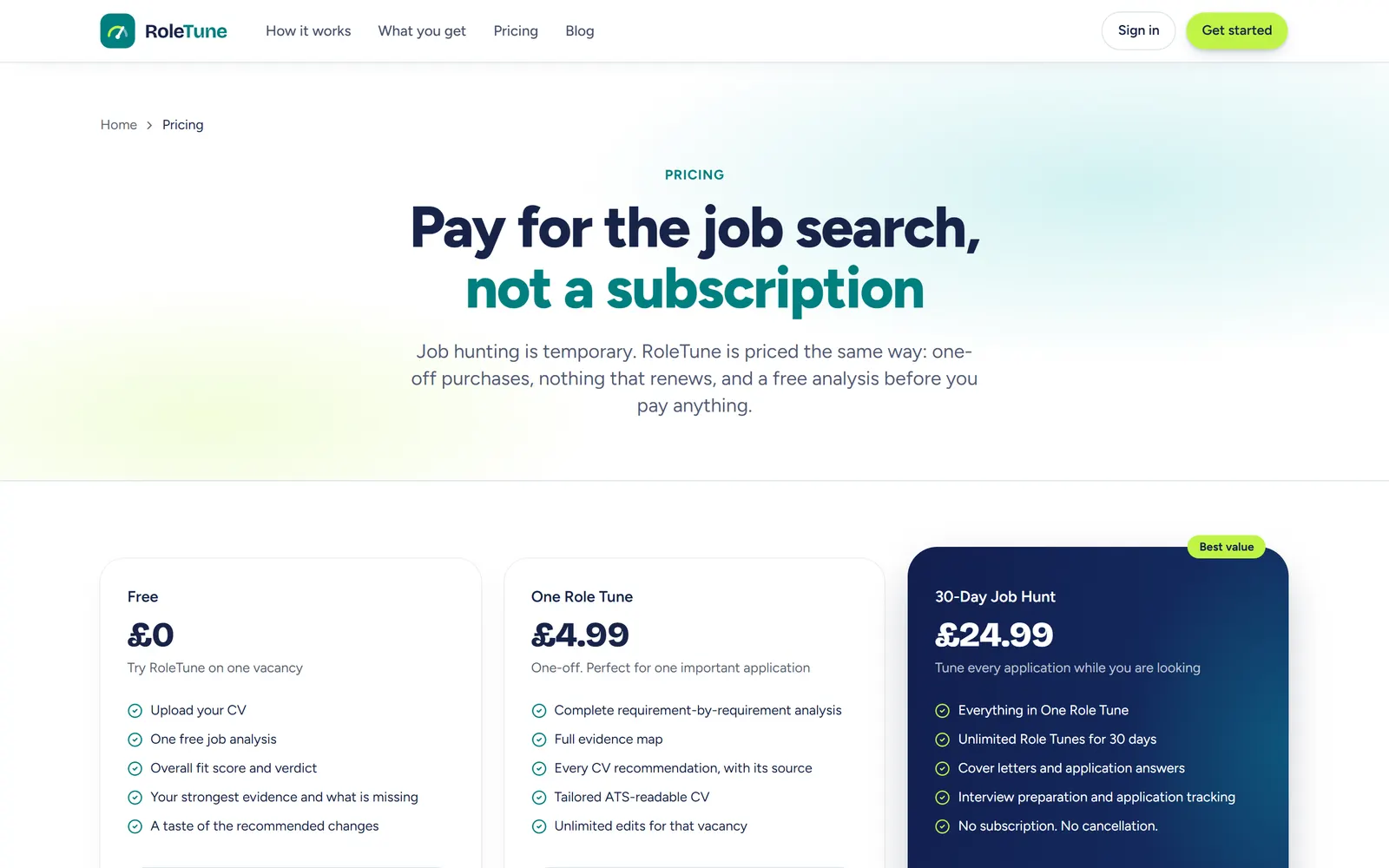
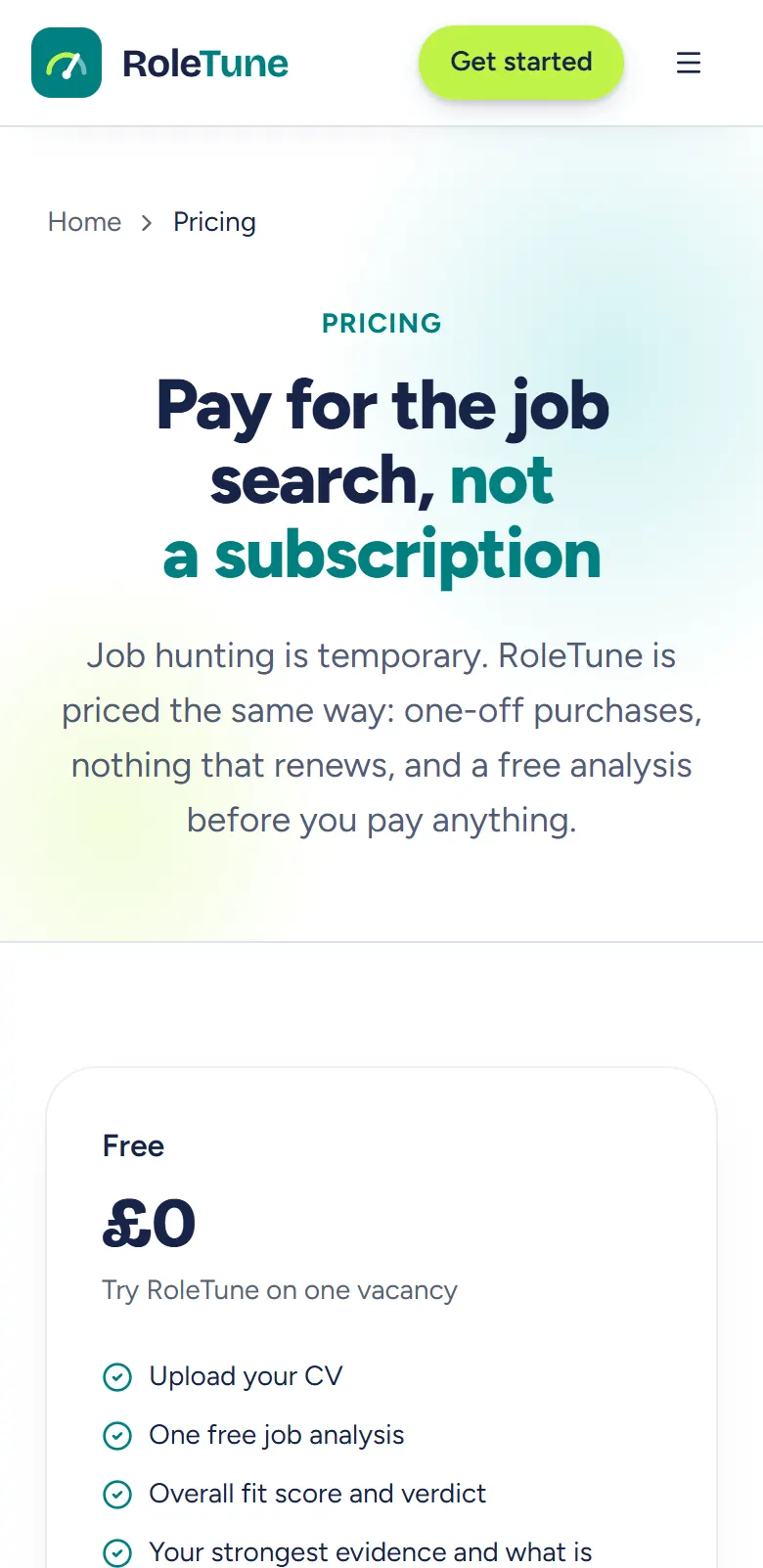
- Free first analysis; £4.99 one-off Role Tune; £24.99 non-renewing 30-day pass
- Scope
- Product strategy, website and application design, tone of voice, AI workflows, evidence retrieval, document generation, billing, security, SEO
- Period
- Local prototype August 2026; multi-user product September 2026; ongoing
- Live site
- roletune.co.uk
164 applications.
One reply.
RoleTune started with a real user story: 164 applications produced just one response. After moving to an evidence-led approach and focusing on roles that genuinely matched their experience, six later applications reached interview. That is one person’s experience, not a promise of results, but it captures the product’s whole philosophy.
A candidate may have exactly the experience a job needs, buried three roles back, described in another industry’s vocabulary, or missing from the version of the CV they sent. They may also be applying for roles they genuinely do not fit. Rewriting everything more confidently does not tell those two situations apart, and most AI CV tools do precisely that.
The product specification set four principles: relevance, evidence, visibility and credibility. Prioritise what matters for this vacancy; trace every claim to something the candidate supplied; make relevant experience easier to see; and keep the candidate’s own voice, with no invented achievements and none of the “visionary, dynamic, results-driven” vocabulary of an inflated CV.
Four states,
no bluffing.
Each requirement in a vacancy gets one of four evidence states. The interface, the AI workflow and the data model all use the same four words, so a user can see at a glance what is strong, what is hidden, what is arguable and what simply is not there. The fit score is RoleTune’s analysis, not an employer’s view and not a prediction.
- Strong evidence
- The supplied CV already demonstrates the requirement
- Hidden evidence
- Relevant experience is buried or described differently
- Possible evidence
- Related experience exists, but does not justify the claim outright
- No evidence
- The claim is left out rather than invented
Show the product,
not an icon.
The identity is ink-navy text on near-white, a teal brand colour and a lime call-to-action. Figtree for headlines and interface, Geist for reading, Caveat for the handwritten notes, and a tuning-dial mark that connects the name to adjusting presentation rather than inventing a new career. CSS tokens carry the palette, surfaces and status colours through the public site, the sign-in screens and the application shell alike.
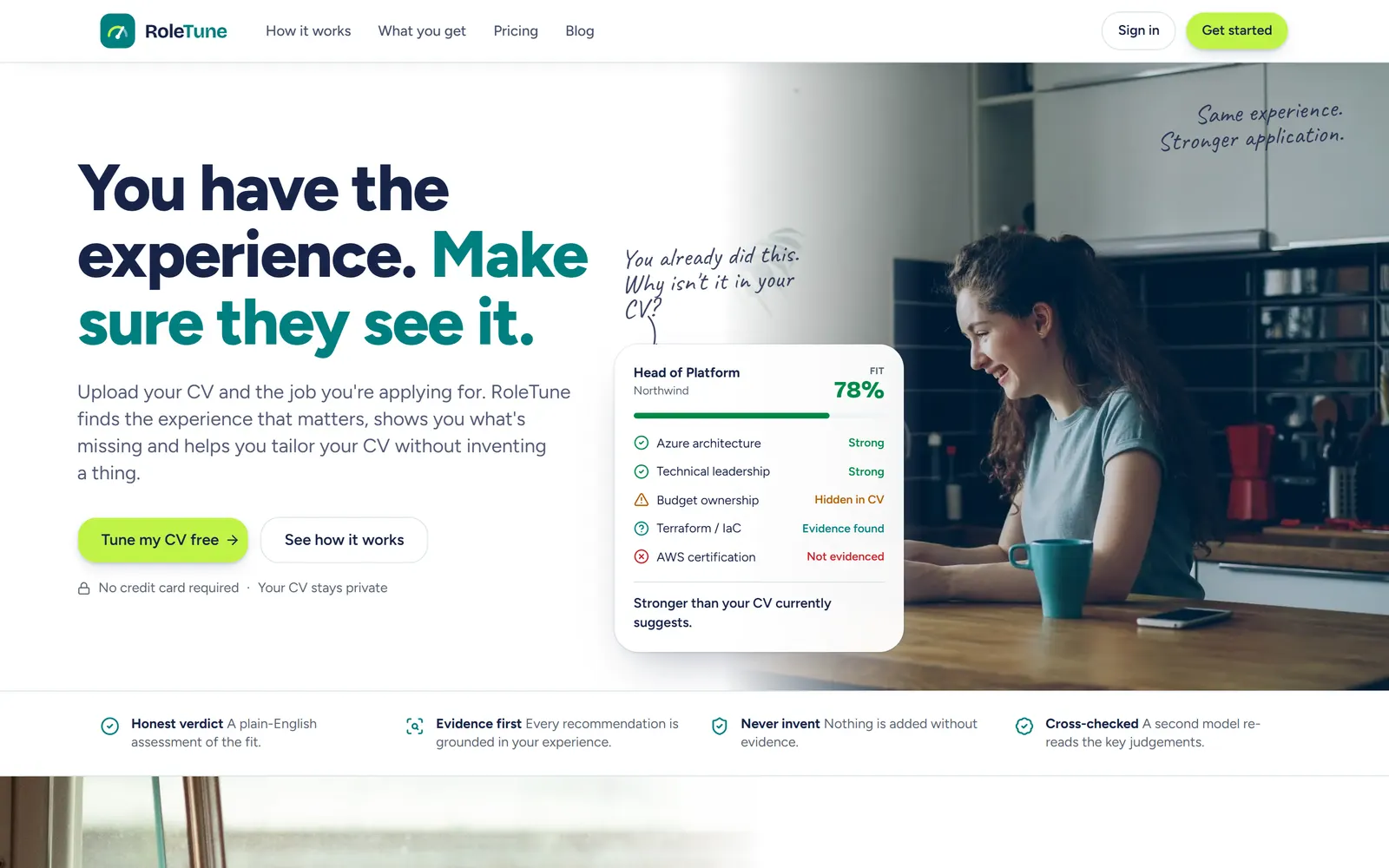
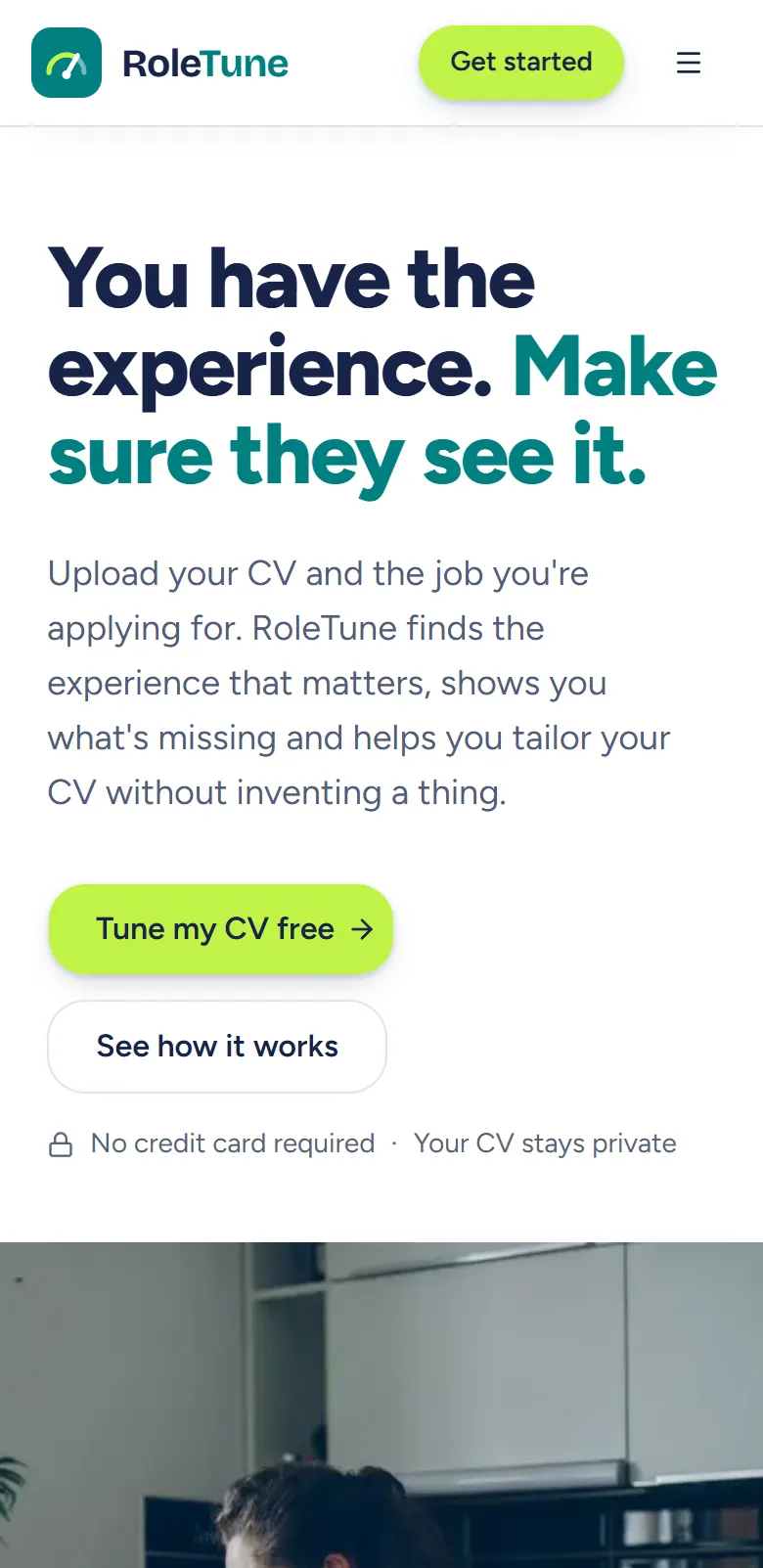
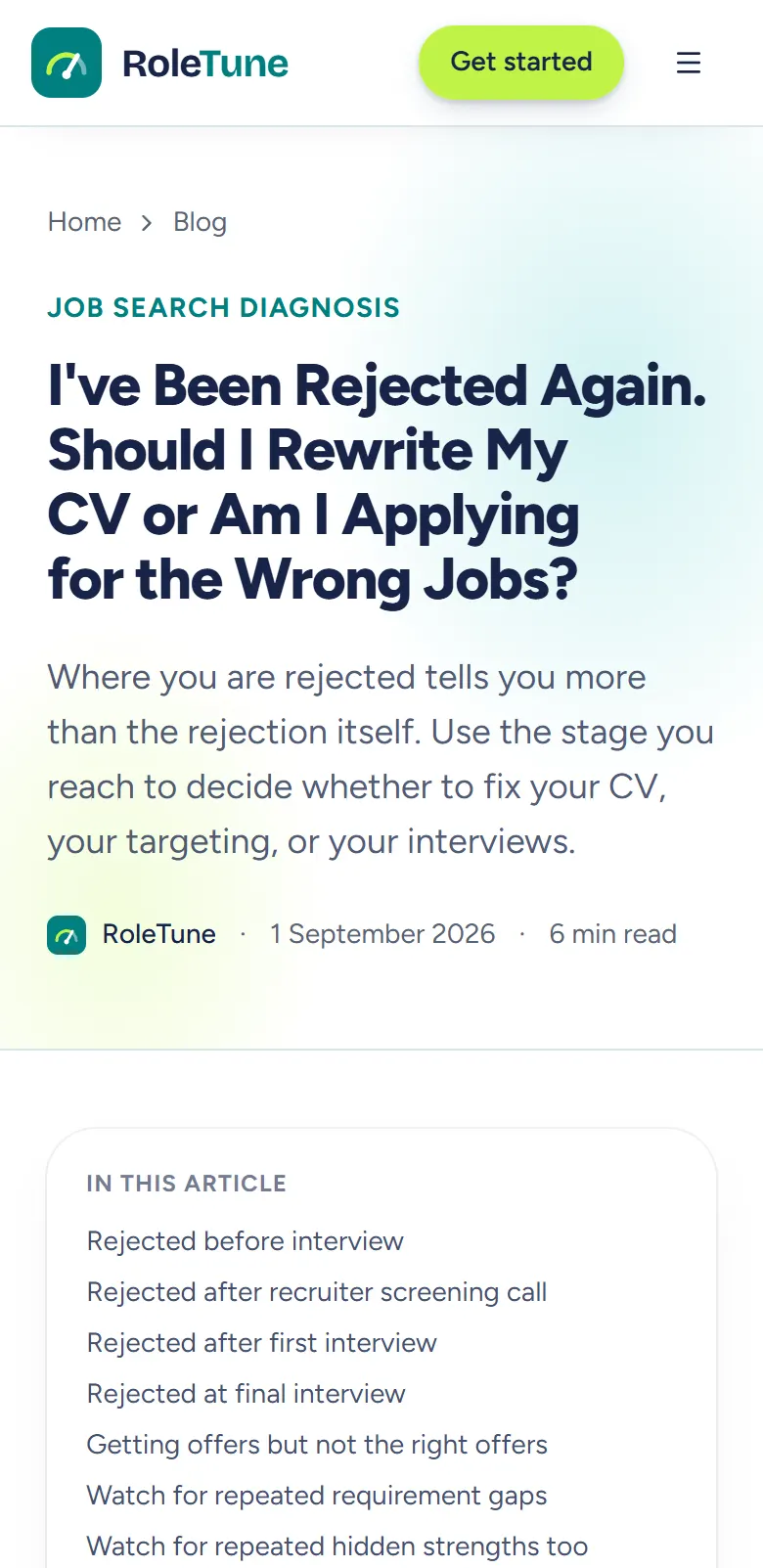
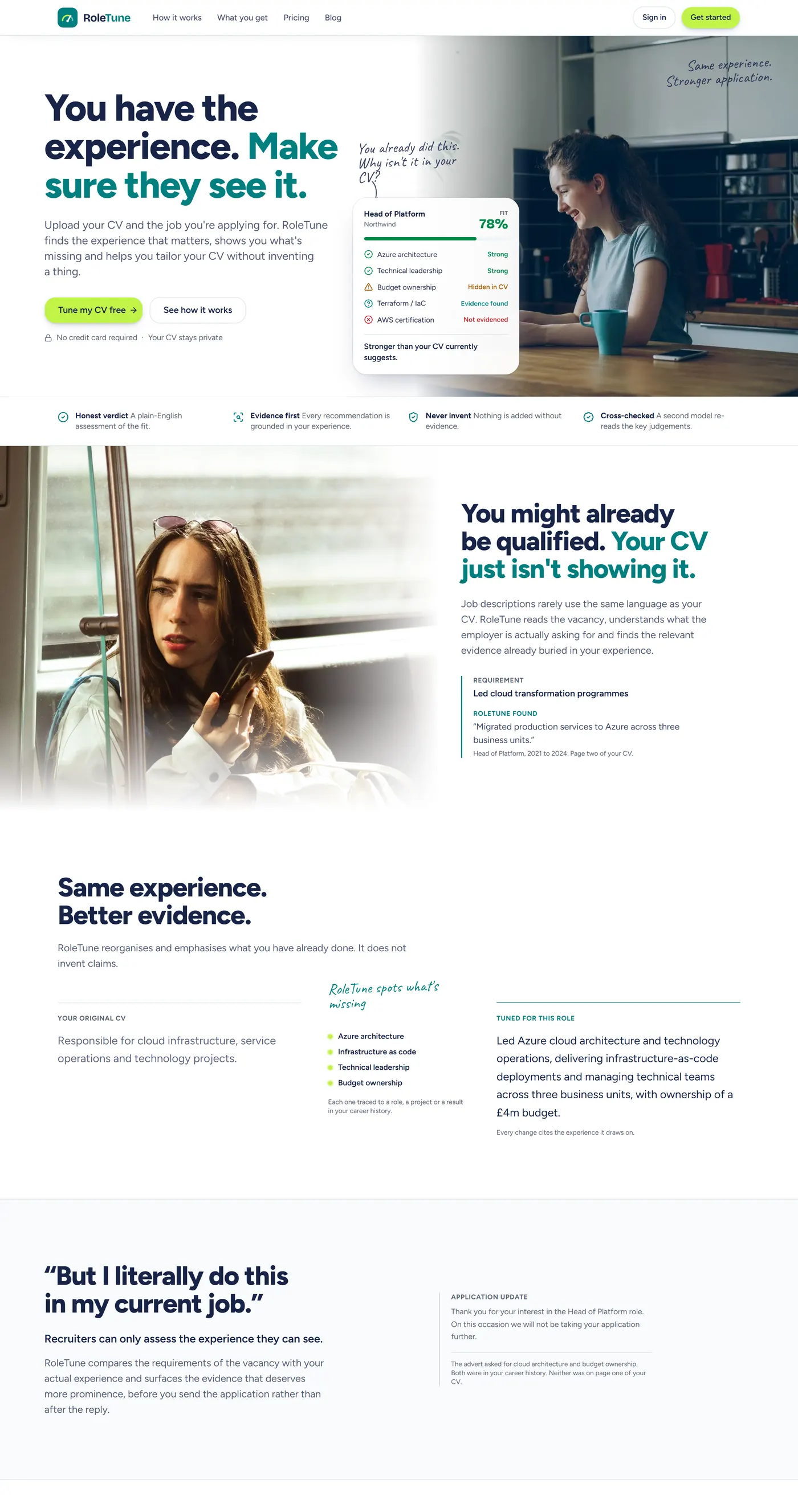
The redesigned homepage leads with the product’s output. A photograph carries a fit-analysis card for a sample role: a score, then each requirement marked Strong, Hidden in CV, Evidence found or Not evidenced. Handwritten notes ask the question the page answers: “You already did this. Why isn’t it in your CV?” Further down, a requirement sits beside the quoted CV line that proves it, and a vague original CV line is shown next to its tuned version with the evidence in between. The page shows the mechanism behind the promise rather than describing it.
Inside the app, a sidebar and mobile navigation connect the dashboard, Career Profile, applications, CVs, insights and billing. Score rings, verdict banners and evidence badges organise the analysis, and source references let a user inspect the basis of any recommendation. Early real use fixed real things: a slow PDF download that looked unresponsive gained a spinner and clear notifications; technical export links left the customer interface; the mobile menu became accessible; reduced-motion users get a stationary progress indicator.
Decide whether to apply,
then how.
A user uploads a PDF or DOCX CV. Text is extracted, then the AI layer identifies career evidence and profile details. Extraction is inspectable: a coverage report shows which sections were captured, partly captured or missed, every fact must match an excerpt from the source, and unresolved references are downgraded rather than shown as complete. The upload is not a black box; the user reviews and corrects the evidence.
Paste a job advert and the application extracts its requirements, retrieves the relevant evidence and presents a criterion-by-criterion matrix: importance, evidence strength, visibility and gap type. Gaps are categorised, from terminology and visibility problems through transferable experience to genuine gaps and hard blockers. The verdict follows explicit rules: a hard blocker means “not recommended”; otherwise a score of 60 or more means “pursue” and less means “pursue with caution”. Product rules, not validated hiring thresholds, and the point is to help someone decide whether and how to apply rather than to produce a more confident CV for every vacancy.
Recommended edits name the proposed wording and the evidence that supports it. The integrity layer resolves citations and drops suggestions without a valid source. The assembled CV is generated as a text-based A4 PDF through headless Chromium with a layout designed for straightforward parsing. ATS-readable, by design; not a guarantee of passing any particular screening system.
Documents as
records.
Each opportunity became a persistent workspace. Saving, regenerating or restoring a document creates an immutable revision; an updated profile never silently rewrites an earlier application; changed or deleted evidence flags dependent documents for review while their history stays intact. Revision numbers are serialised with row locks, and generation carries an expiring lock and rate limits, because two requests can finish out of order.
- Role Match
- Score, verdict, requirement-by-requirement analysis and evidence links
- Tailored CV
- Saved output, revisions and PDF download
- Cover letter
- Evidence-grounded drafts and editable versions
- Application answers
- Question classification, source-backed answers and STAR support where useful
- Interview prep
- Likely questions, evidence-based talking points, gap preparation and questions to ask
- Notes and activity
- Notes, status history, dates, interview records and follow-up drafts
- Outcomes
- Application feedback, interview and offer tracking, and an accepted-role completion
Six layers
between a model and a claim.
- Layer 01
Sources must match
Extracted facts require a matching excerpt from the uploaded CV; uncertain material is labelled and needs review.
- Layer 02
Retrieval filters first
Ineligible or unconfirmed evidence is excluded before anything reaches generation.
- Layer 03
Edits carry identifiers
Requirement matches and recommended edits reference evidence records, not just model prose.
- Layer 04
Drafts are verified
Supporting documents validate citations and quotations, then a separate model call checks them against the sources.
- Layer 05
Claims can be withheld
Unsupported, partial or ambiguous CV changes are held back and the user is asked to clarify.
- Layer 06
Facts are rechecked on save
Final persistence confirms the underlying evidence has not changed or been deleted while generation ran.
A verification call is a separate check inside the same AI system, not a human review and not proof that hallucination is impossible. The combination of deterministic validation, user review and model checks is what the product relies on. In the recorded live test with synthetic facts, a supported team-size claim went through and an invented £5 million budget was rejected: a specific test case, not an accuracy percentage.
Meaning,
not just keywords.
Retrieval combines keyword overlap, semantic similarity and evidence-quality signals. Azure embeddings and pgvector rank a bounded set of relevant evidence per requirement before the model judges the matches. Search is scoped to the owner’s eligible evidence, vectors are invalidated when evidence or model configuration changes, exact repeat uploads skip re-extraction, and a keyword-only fallback reports itself when embeddings are unavailable.
Ownership is derived from Clerk on the server, with row-level security on the tables and browser data-API grants revoked. Migrations carry backfills and access control statements; integration tests use Docker and synthetic users, never production records. Implemented safeguards, not a certification.
- Application
- Next.js 16 App Router, React 19, TypeScript
- Interface
- Tailwind v4 tokens, shadcn with Base UI, Figtree, Geist and Caveat, Bricolage Grotesque for the wordmark
- Identity
- Clerk, resource-level protection, server-derived ownership, row-level security
- Data
- Prisma 6 and PostgreSQL with versioned migrations; Supabase in production
- Retrieval
- Azure text-embedding-3-small, 1,536-dimensional vectors, pgvector cosine ranking scoped per owner, keyword fallback
- Generation
- Claude through the Anthropic SDK, via Azure AI Foundry or the direct API, with Zod-validated structured output
- Ingestion and export
- Mammoth and pdf-parse in; HTML/CSS assembly to A4 PDF via headless Chromium out
- Billing
- Stripe Checkout, signature-checked webhook, transactional entitlements, idempotent grants
- Publishing
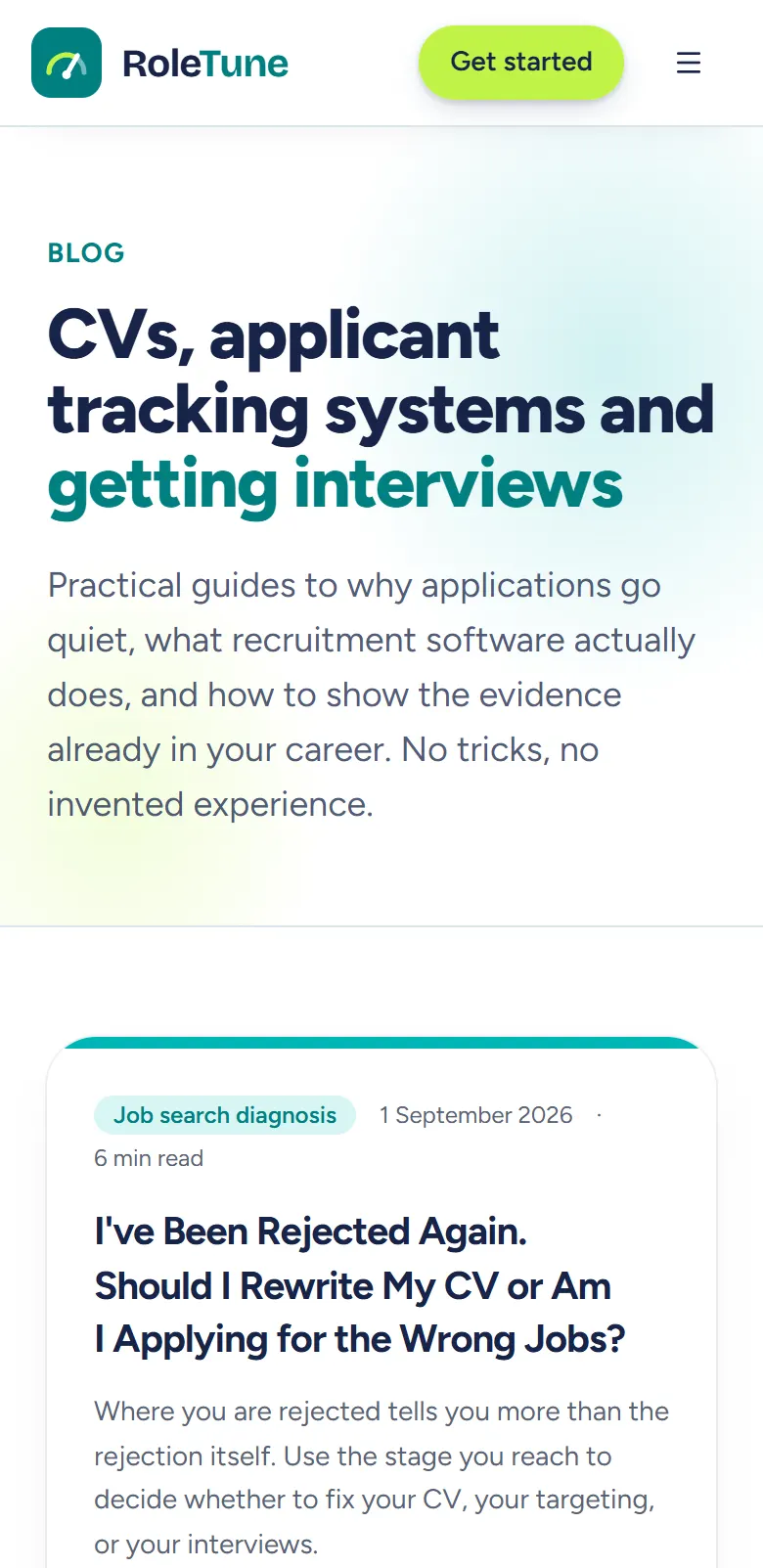
- Markdown blog and legal content, structured data, generated social cards, sitemap
12,234
Prompt-cache tokens, written once, read in full
September test: stable career content ordered ahead of the changing job advert, with cache breakpoints. The first run wrote 12,234 cache tokens; the second read all of them. Verified reuse for a repeated analysis, not a bill reduction claim.
- 70default tests
- 15real database tests, Docker
- 2live Claude tests, synthetic facts
- 4pages: first production PDF, 6 Sept
Historical verification records from the Phase 3 handover and the September deployment, not tests rerun for this page. A live Azure and pgvector test also confirmed semantic ranking and exclusion of another user’s evidence.

Built.
Being proven.
What is evidenced: a personal local tool evolved into a branded, multi-user application with account ownership and billing; CV recommendations connected to reviewable sources with explicit handling of uncertainty and genuine gaps; persistent workspaces with immutable revision history; reusable career evidence and private semantic retrieval; verified production PDF delivery and a specific prompt-cache reuse scenario; and a public content and SEO foundation refined from an audit of all 11 public pages.
What we do not claim: typical interview uplift, ATS bypass, guaranteed truthful output, paying customers or search growth. The first real purchase and the complete signed-in production journey for the career features are still to be confirmed. Next: those confirmations, analysis latency and cost measurement, stronger sourced editorial with real worked examples, and an organic baseline to measure against.
AI that shows
its sources.
RoleTune is what we think an AI product should look like: useful, restrained, and honest about what it knows. If your business has an AI idea, this is the standard we would build it to.
Got an AI idea
worth building properly?
Or just email
hello@stourbridgewebstudio.co.uk