Fixtyerpothole claims,made sense of.
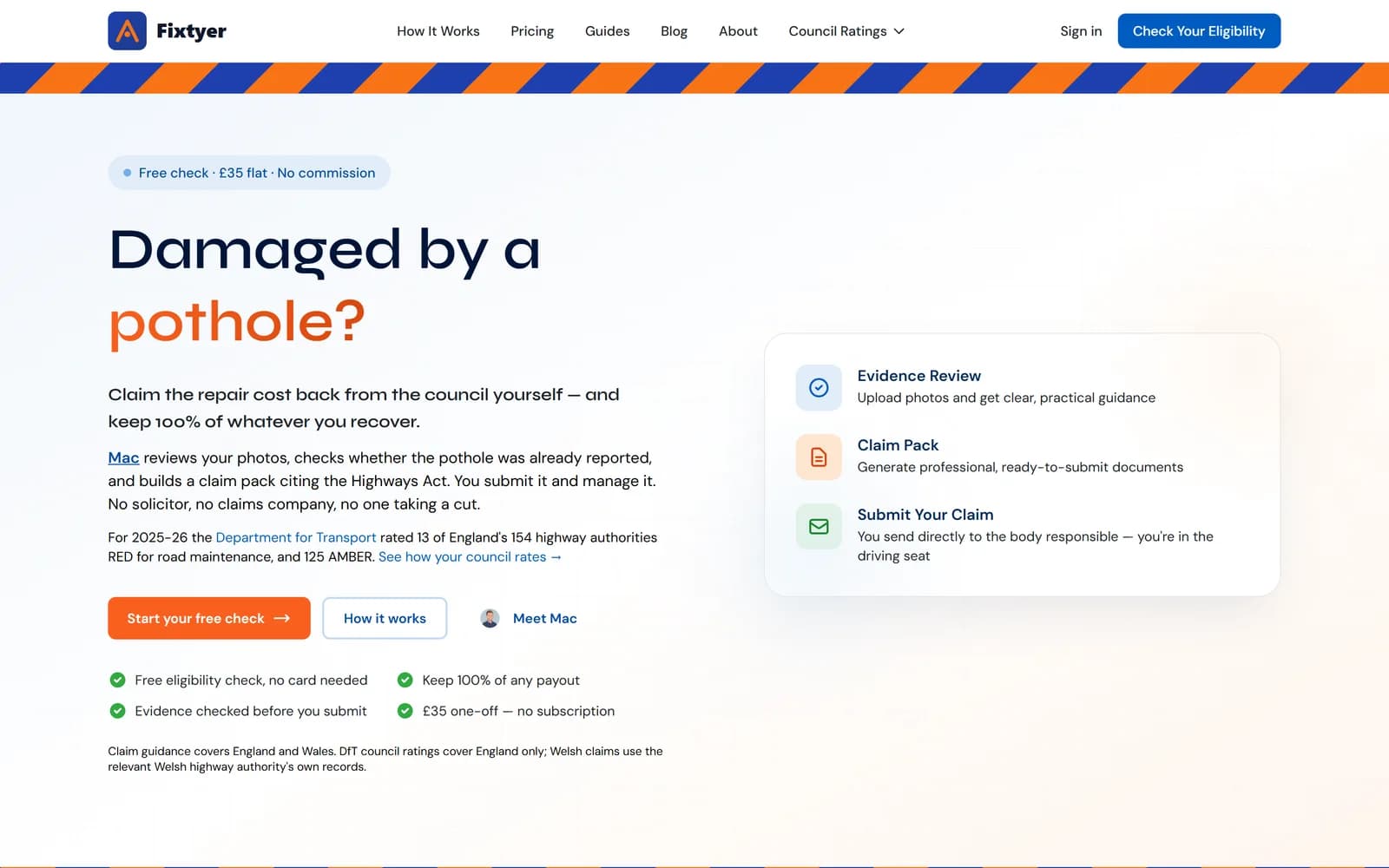
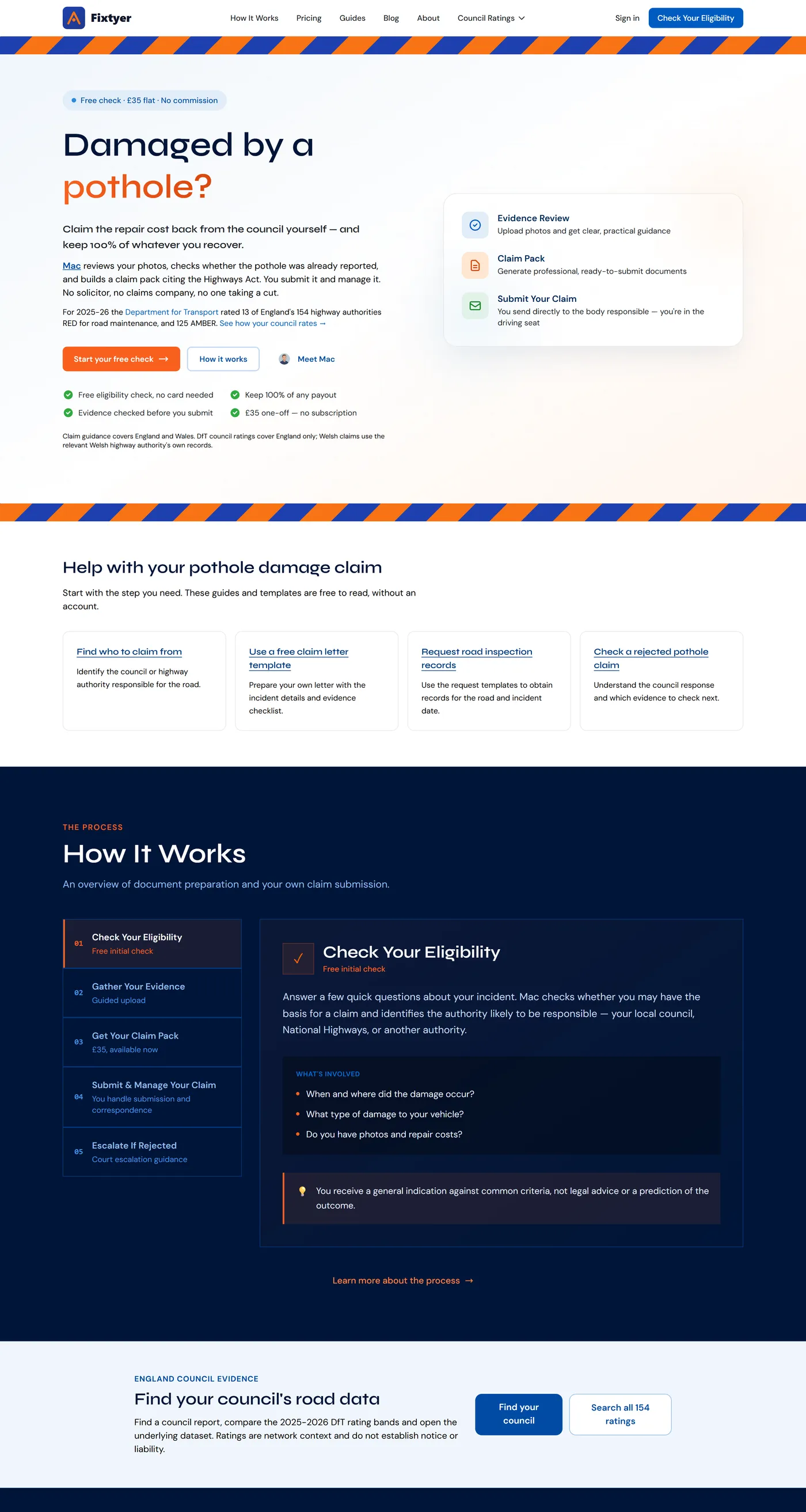
A full product, not a brochure site. Fixtyer brings a free initial check, practical guidance, AI-assisted evidence review and a paid document pack into one self-service journey, alongside a council research library of more than 150 authorities. We designed it, built it and run it.
- Product
- Fixtyer, by Elevyn Technology Group
- Type
- Web application and public information library
- Audience
- Motorists in England and Wales preparing their own pothole-damage claim
- Model
- Free check and guidance; £35 one-off Council Claim Pack; no commission
- Scope
- Product and website design, interface copy, AI-assisted evidence workflows, payments, PDF generation, public data publishing, SEO, analytics, operational tooling
- Period
- Specified January 2026, built through the year, ongoing
- Live site
- fixtyer.co.uk
Five questions,
five systems.
A motorist with a bent wheel and a repair bill has to answer several questions before they can claim a penny: who manages that stretch of road, what evidence is needed, whether the pothole had already been reported, what paperwork to assemble and how to submit it. Each answer lives in a different place. Most people give up, or hand a third of any payout to a claims company.
Fixtyer pulls those tasks into one journey while keeping an important boundary intact: the customer reviews, submits and manages their own claim. The product prepares documents and explains the process. It does not represent anyone, and it does not promise an outcome.
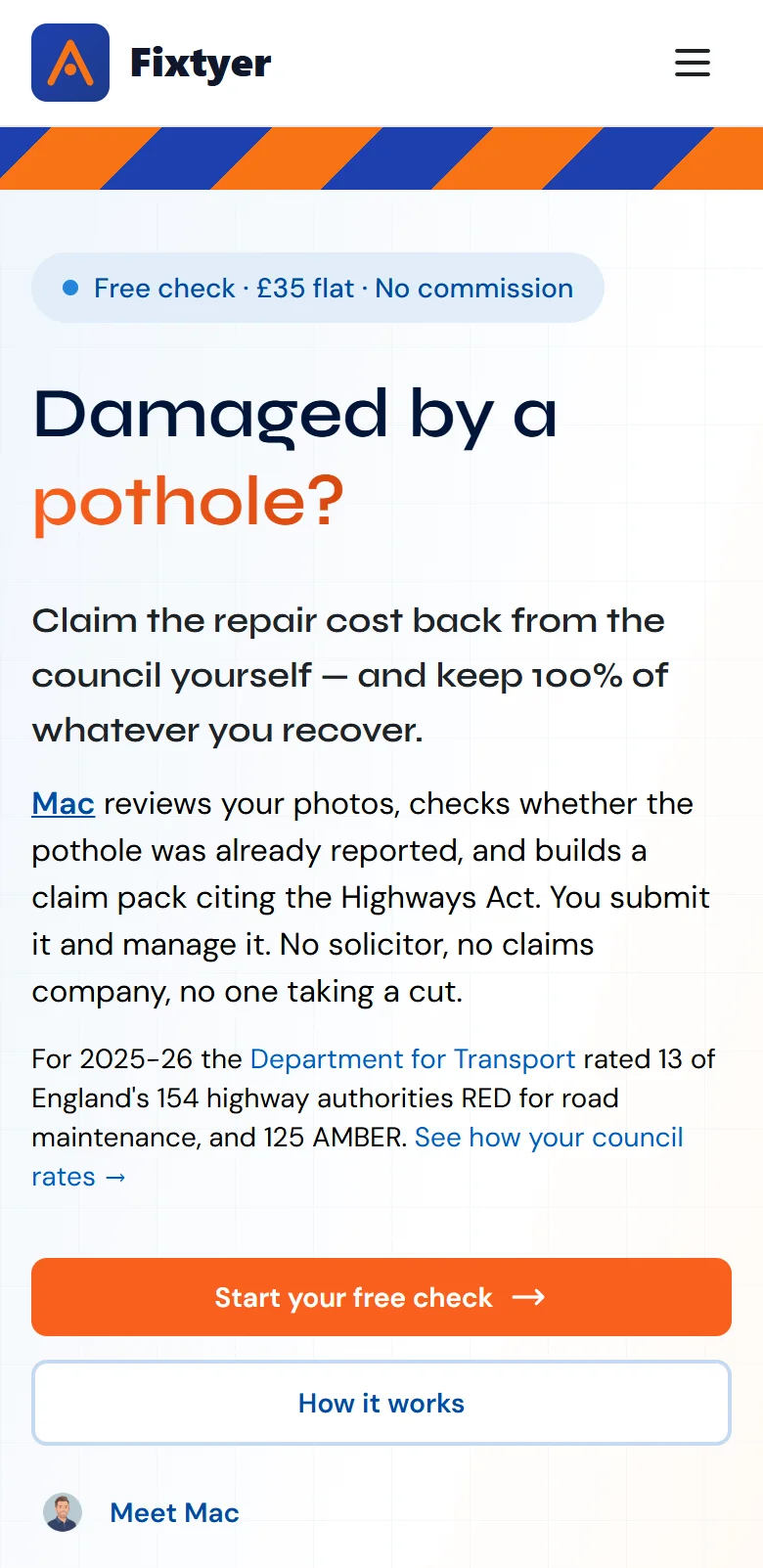
That framing set the design problems. Make an unfamiliar, stressful process understandable without demanding registration first. Turn photographs and receipts into clear next actions. Present AI help honestly, as software, not an expert. Make a very large public library discoverable next to a private application. And make payment, background generation and file delivery reliable across separate services.
Value first,
account later.
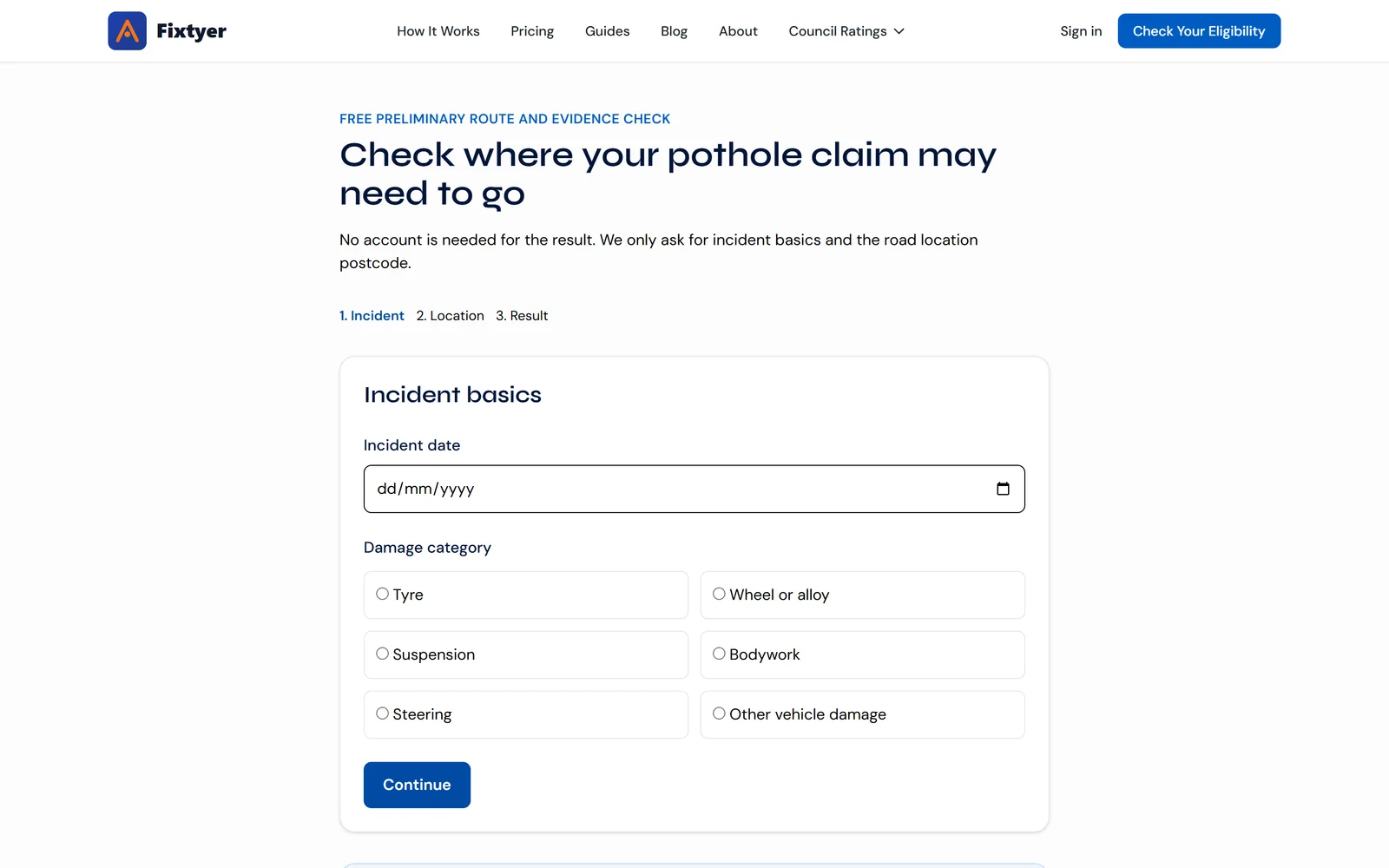
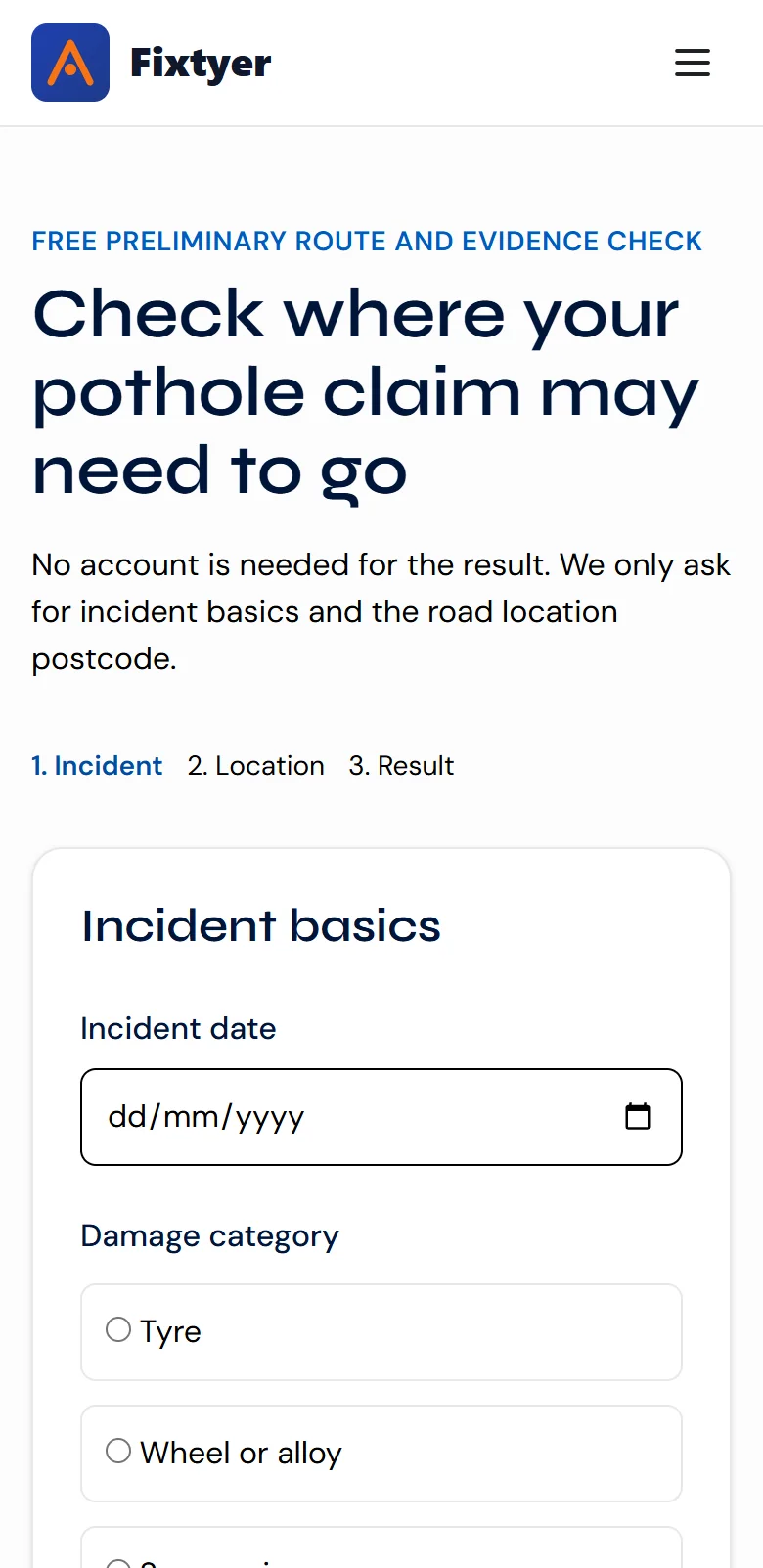
The public journey now starts at the free check. A guest gives the incident basics, the damage type and the road postcode, and gets an authority preview and an evidence checklist before being asked to save their progress by registering. Only the normalised postcode is sent to the preview endpoint; nothing creates a claim record until there is an account.
The preview is deliberately modest. A postcode suggests an authority; it does not settle who manages every road, so the interface supports uncertain results and asks the customer to confirm. The draft survives registration and is cleared once a real claim exists. Show something useful, then keep the work already done.
- 01Free check
- 02Register
- 03Evidence
- 04AI review
- 05Pay £35
- 06Pack ready
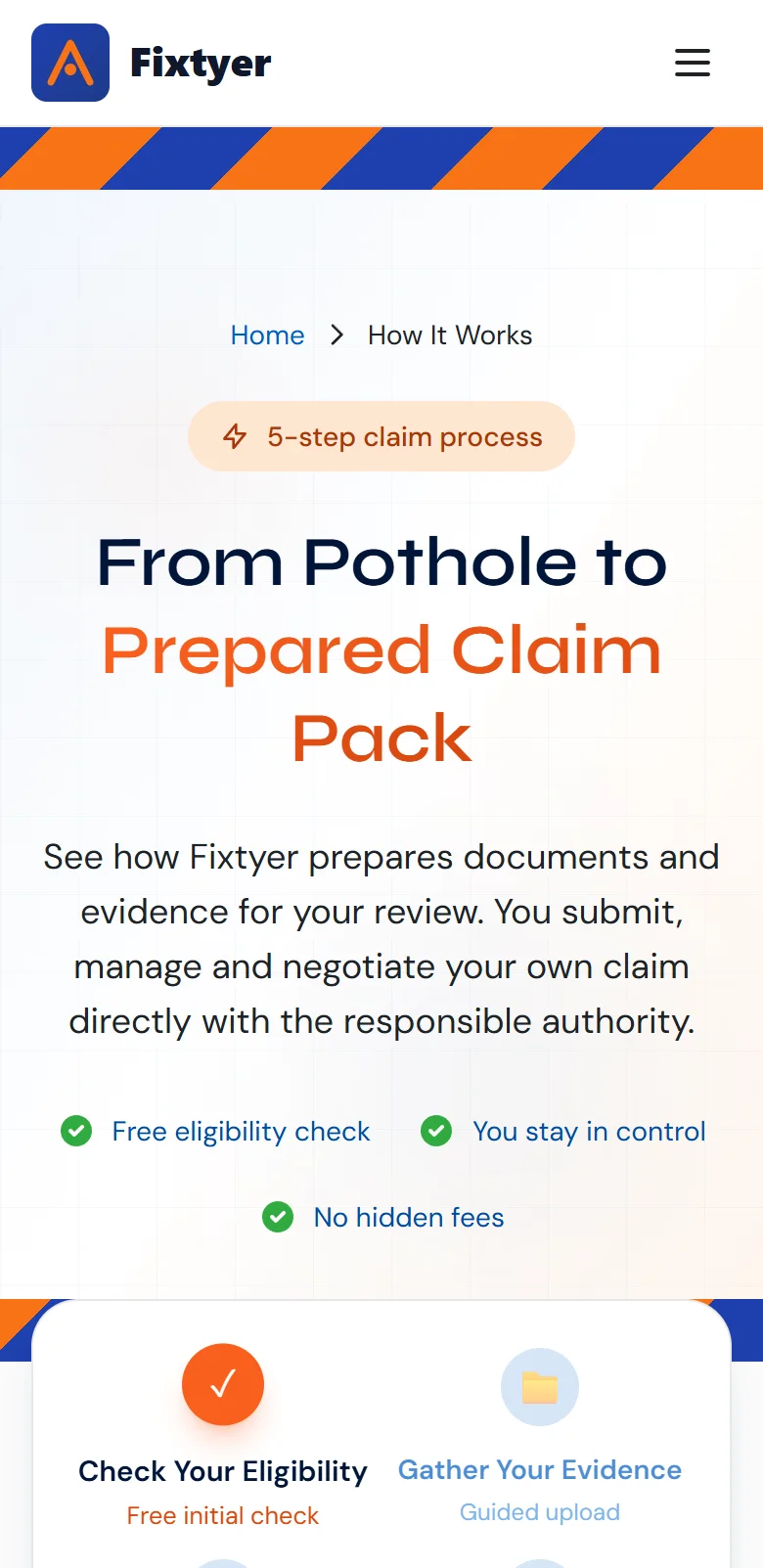
Roadworks colours,
plain words.
The identity is deliberately practical: a strong blue, orange for every call to action, and diagonal blue-and-orange stripes borrowed from the roadside. Syne for display, DM Sans for reading. Pale surfaces, rounded cards and clear status colours keep the denser application screens legible. Everything is expressed as Tailwind theme tokens and shared components, so the public site and the logged-in application share one language while serving different jobs.
Much of the real design work is in the in-between states: upload feedback, evidence gaps, analysis in progress, an uncertain authority, a payment that is still processing, a session that needs refreshing. Optimistic uploads, manual vehicle entry when the registration lookup fails, guarded payment-modal closure and clear wizard errors are what make the service usable when an external service is slow.
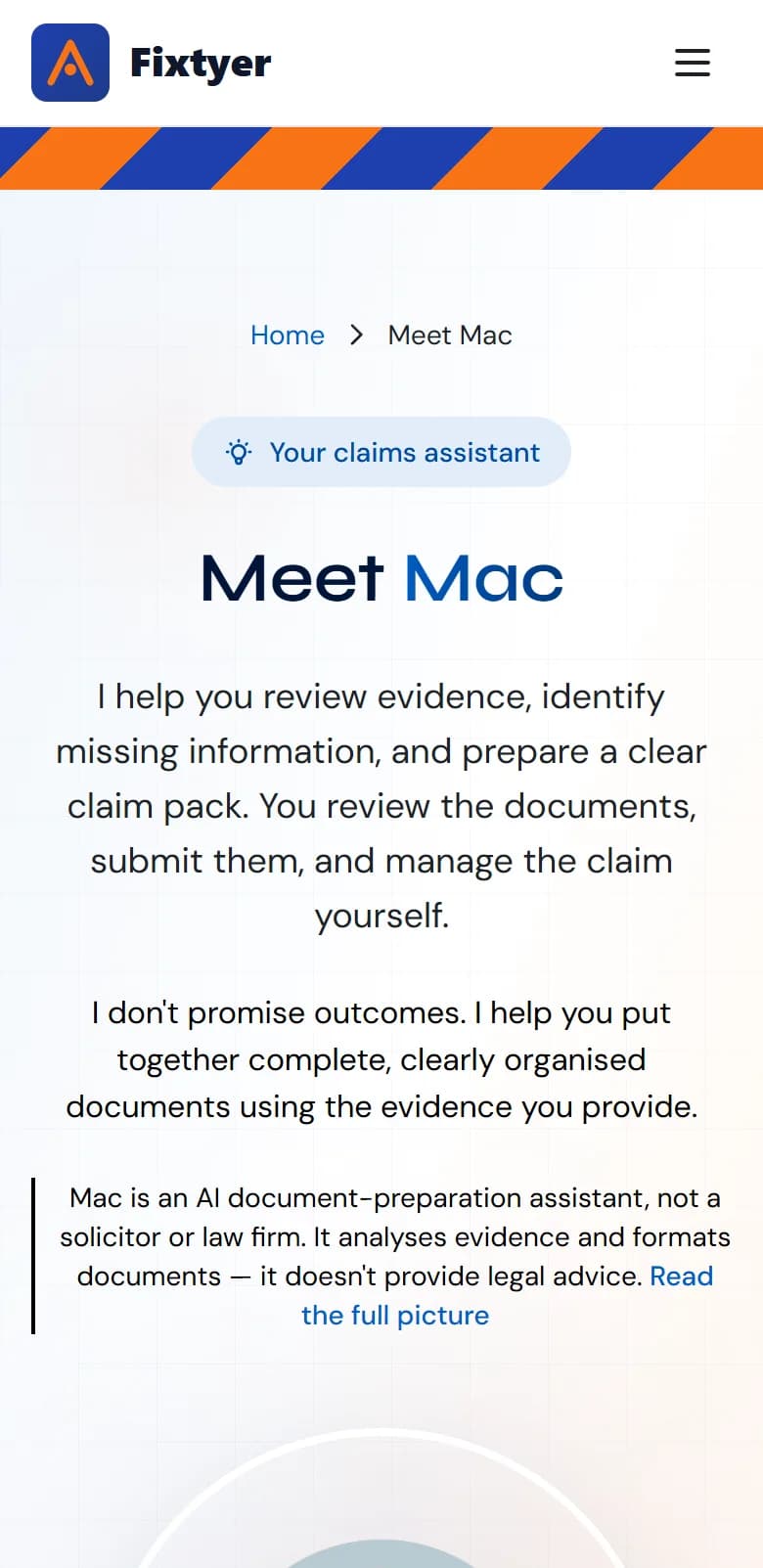
Mac is the persona for evidence review, and the site says plainly that Mac is software, not a person, and what Mac cannot do. The voice is direct British English: what you have supplied, what is missing, what to do next. “You’ve made a start, but there are gaps to fill.” A plain-English summary sits beside evidence categories, priority actions and photo guidance, rather than an unexplained score. Keyboard focus, labelled controls and interaction-level accessibility fixes are implemented work, not a certified conformance claim.
Not a chatbot.
A workflow.
AI is used for specific preparation tasks, each with structured output, run as background jobs with retries and failure reporting. The evidence score is feedback about the supplied evidence, not a probability of success.
- Image triage
- Relevance and type assessment before deeper analysisIdentify usable evidence and the right processing path
- Document analysis
- Claude vision and text analysis; Azure Document Intelligence OCRExtract and assess information from photographs, invoices and quotes
- Bundle review
- Combined evidence assessment with structured outputExplain strengths, gaps and next actions across the whole claim
- Draft wording
- Incident-description refinementMake the customer's own account clearer, for their review
- Pack preparation
- Template assembly from structured facts and evidenceProduce an organised, reviewable document bundle
Facts in,
documents out.
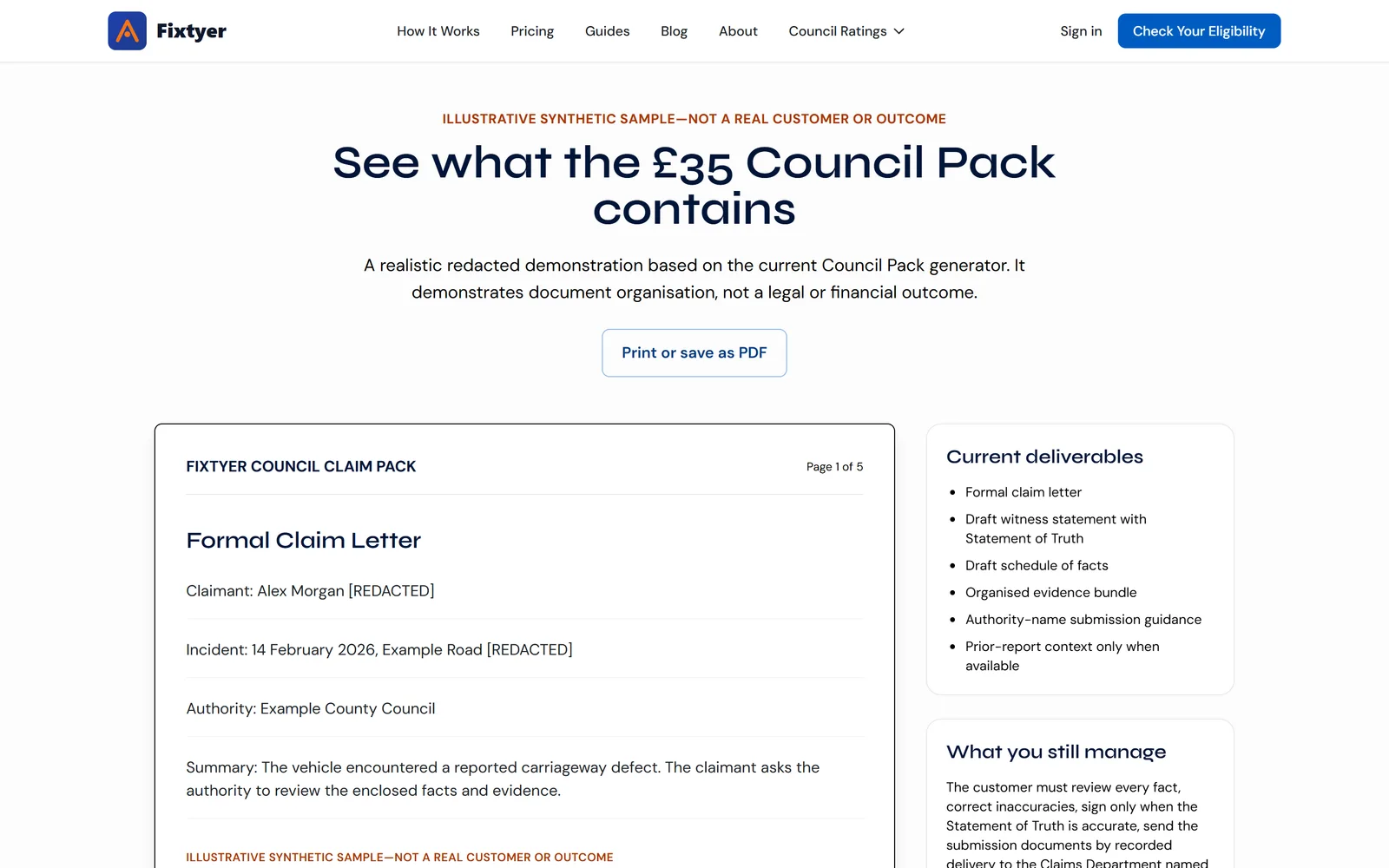
The paid artefact is a substantial part of the product. A successful £35 payment, through embedded Stripe payment components with server-side handling, triggers background generation, file storage and a pack-ready email. The pack itself is built with pdf-lib and embedded fonts: cover, next steps and evidence checklist for the customer; a formal claim letter, draft witness statement and schedule of facts; location information, defect and damage photographs, financial evidence and any prior-report material.
The most useful engineering decision is the boundary between supplied facts and generated interpretation. Shared fact helpers use only what the claimant provided and the document categories that exist. They do not invent driver status, sensory detail, missing dates or a submission event. The draft witness statement is built from structured damage facts rather than an AI-rewritten narrative, and pre-signing checks ask the customer to verify every page.
Payment and generation share an idempotency key so the webhook and the confirmation request converge on one background run; unique payment identifiers and generation checks guard against duplicates. An £89 Court Pack exists in the product definition but is blocked from purchase until it is built. There are no subscriptions, and the platform never submits or negotiates a claim on the customer’s behalf.
153 councils,
readable before JavaScript.
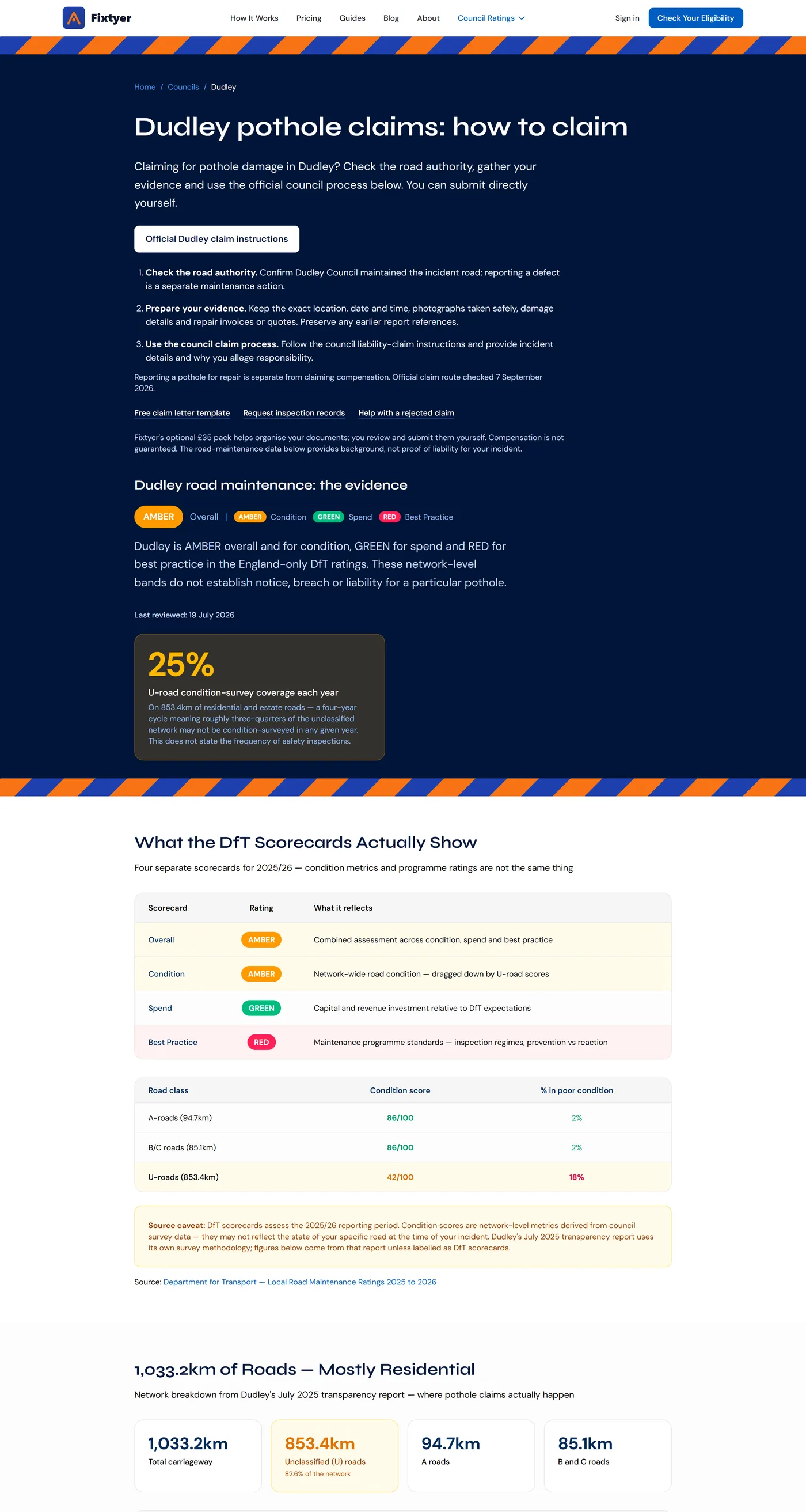
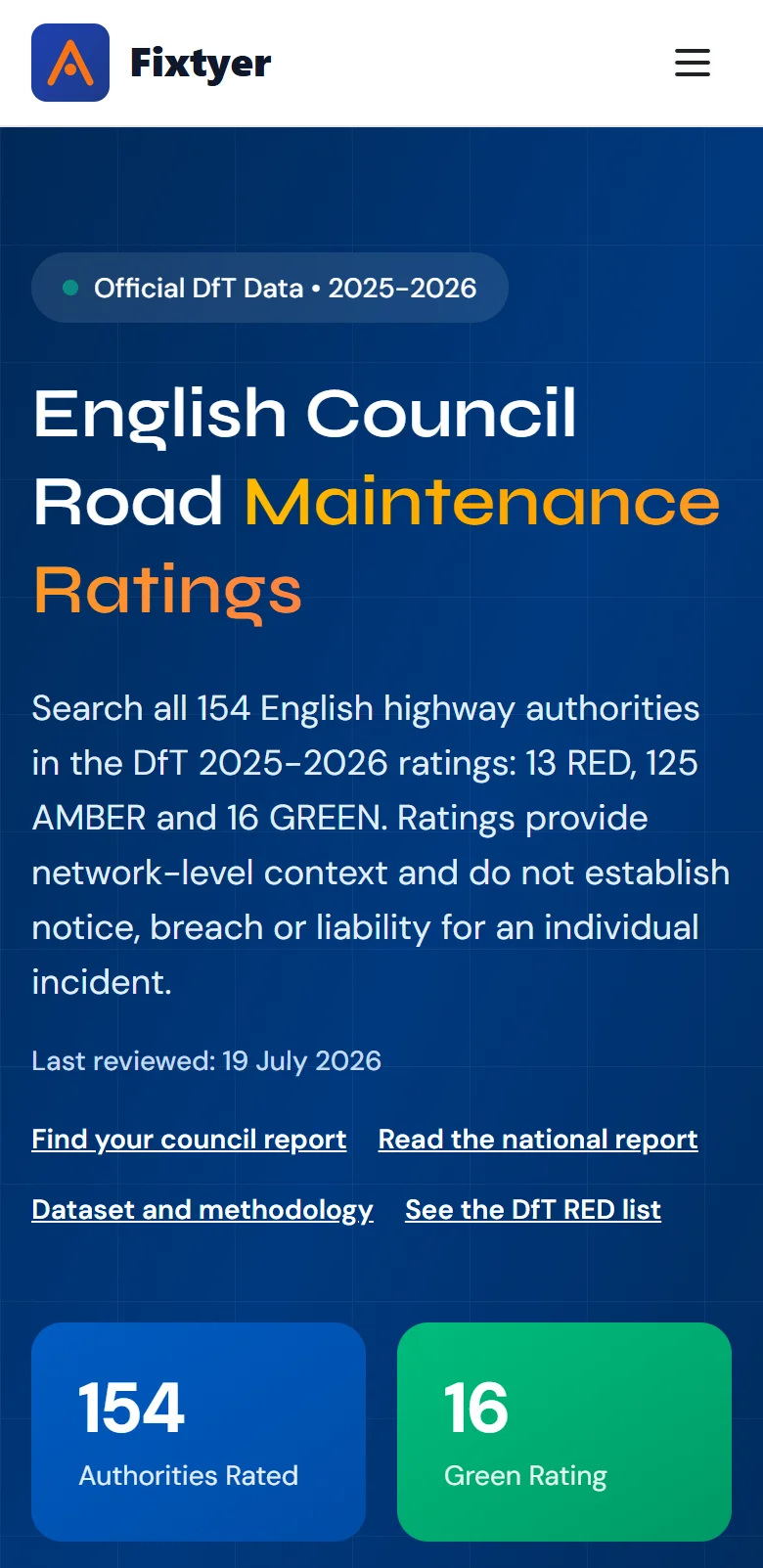
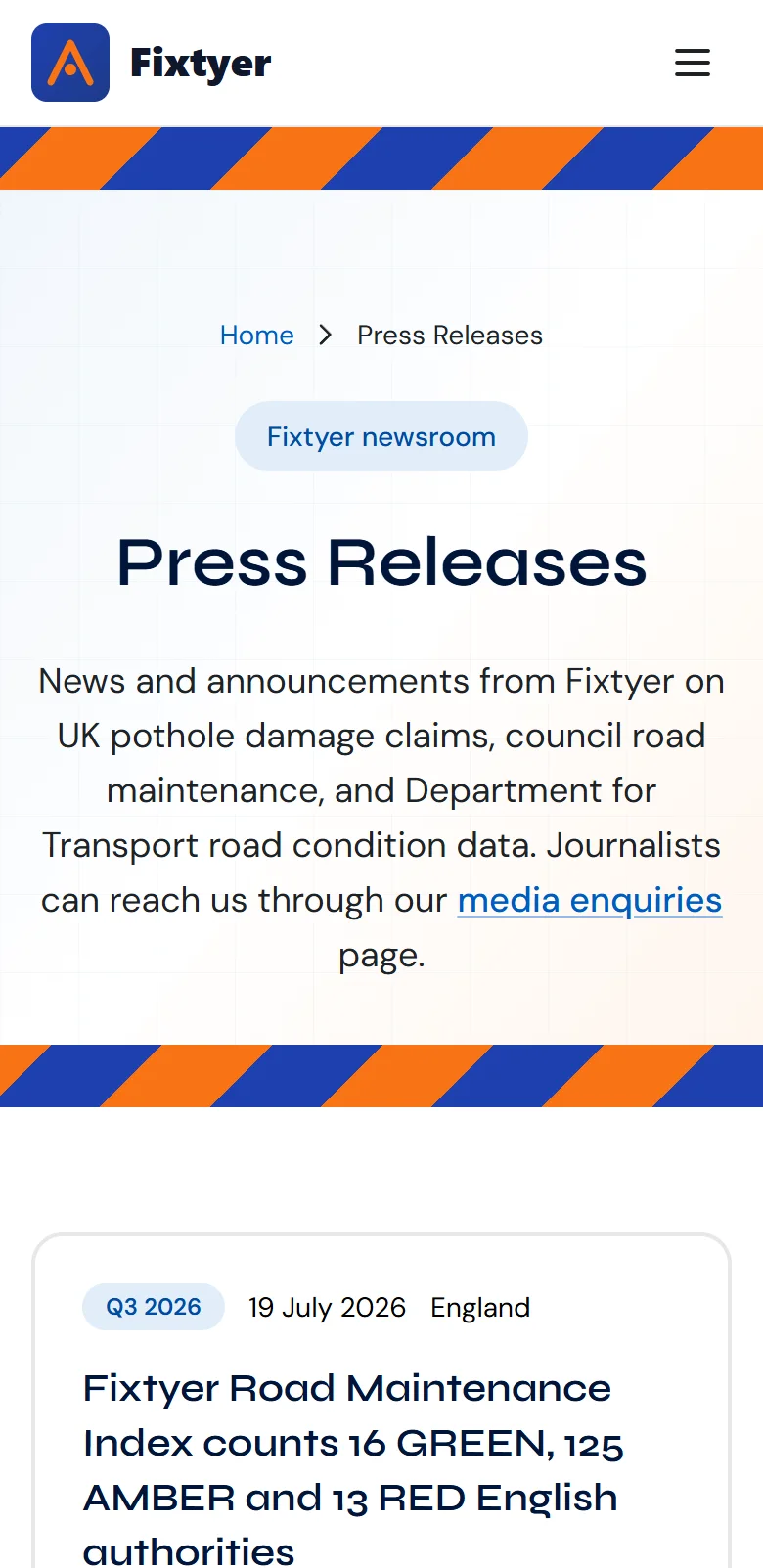
Around the application sits a large public library: a page for each of 153 English highway authorities combining published maintenance information, Department for Transport ratings, source material and practical claim instructions; guides on evidence, responsibility, timelines and rejected claims; a searchable ratings dataset with CSV and JSON exports; sample pack material; and a newsroom whose press releases are shared between web pages and generated, branded PDFs. It is structured data engineering and editorial work together, not a set of place-name landing pages.
The site is React and Vite, which search engines historically read badly. Rather than move to a request-time framework, a server entry renders every public route at build time into page-specific HTML that hydrates in the browser. Serving that correctly from a static host took 185 managed rewrites and 19 header rules across 219 routes, so deep URLs get their own page rather than the homepage shell, and a missing page is a genuine 404. Release tooling checks page identity, canonicals, indexing directives, prerender markers and the deployed commit before a release is finalised.
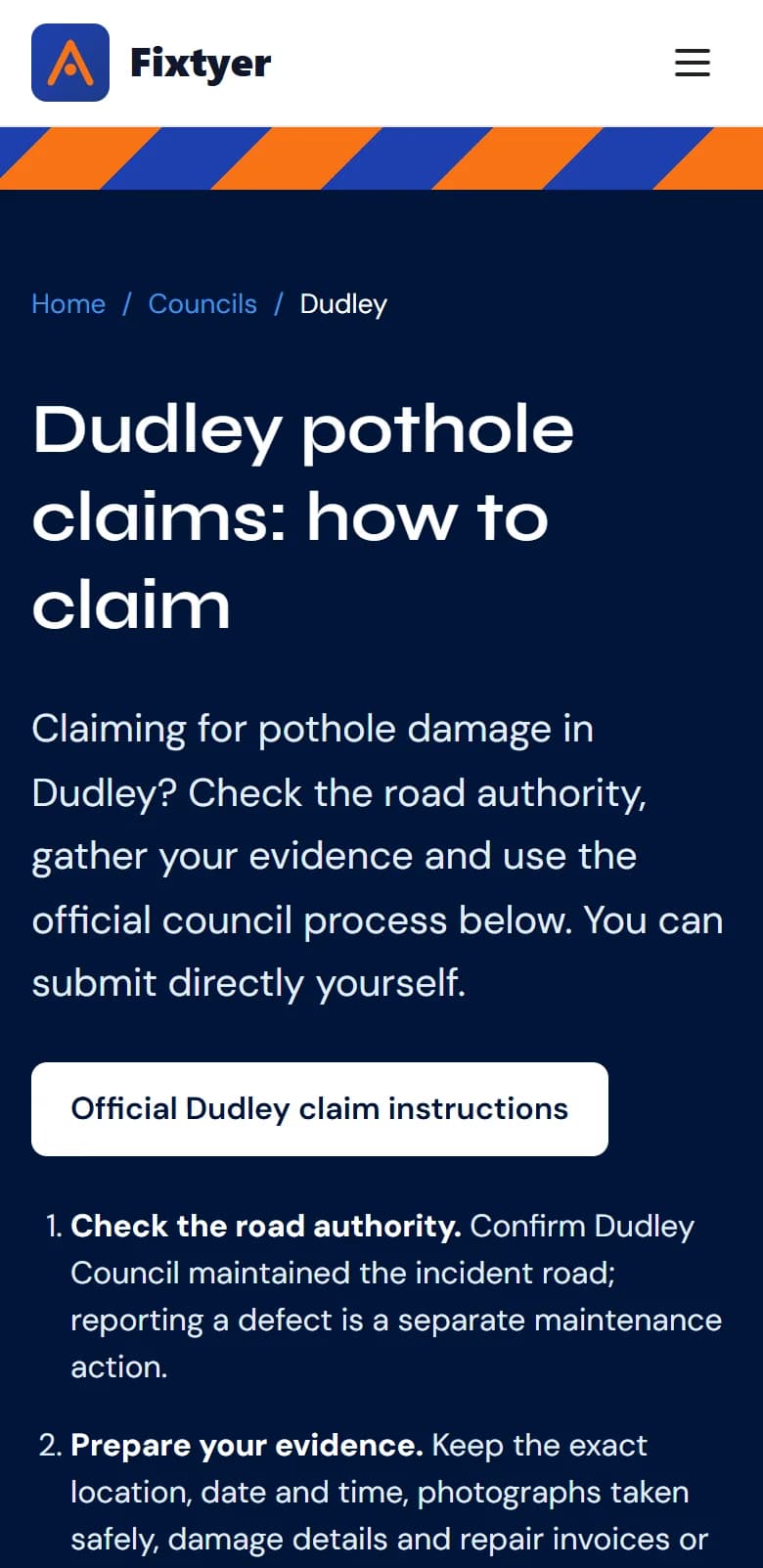
In September, Search Console showed an intent problem: council pages led with maintenance research when visitors wanted to know how to claim. A limited pilot on Dudley, Bristol and West Northamptonshire put claim-focused titles, the checked official submission route, a road-responsibility caveat, the evidence checklist and submission steps ahead of the research. Keep the useful material; put the reader’s task first. The pilot is being measured against a later comparable window before it is rolled out further.
219
Public pages, prerendered
September sitemap crawl, including 153 English council detail pages, each served as page-specific HTML before JavaScript
£35
Flat fee, no commission
A free check and guidance first; a one-off pack; the customer keeps everything they recover
−93%
Press PDF size
A generated press release PDF cut from about 883 KB to 62 KB by font subsetting, June project log
Verified at the September release
Dated records from the release itself, not tests rerun for this page. Authentication and payment integration tests need an isolated database and were not part of that run.
- 287web tests
- 49API tests, database-independent
- 32shared-content tests
- 14live SEO resource checks at release
Built to
be operated.
Health and readiness endpoints, an admin portal with searchable users and an audit log, AI calls inspectable by model, usage and duration, and a consent-aware measurement layer that never sends claim IDs, postcodes, registrations or free text to browser analytics.
- Workspace
- TypeScript monorepo, pnpm workspaces, Turborepo
- Front end
- React 19, Vite 6, React Router 7, Tailwind CSS v4; React Hook Form, Zod, Zustand
- Public rendering
- Build-time React prerendering with page-specific metadata; 185 managed rewrites and 19 header rules on the static host
- API
- Fastify 5 with shared validation and typed contracts; JWT access and refresh flows; server-enforced admin checks
- Data
- Prisma 6 and PostgreSQL; private Vercel Blob storage with time-limited signed URLs
- Background tasks
- Trigger.dev for document analysis, bundle review, prior-report discovery and pack generation, with retries and failure reporting
- AI and OCR
- Claude Haiku 4.5 through Azure AI Foundry; Azure Document Intelligence
- Payments and documents
- Stripe PaymentIntents with embedded payment UI; pdf-lib with embedded fonts; Resend email
- Observability
- Sentry, application activity records, JSONL audit logs, AI token and latency events
- Analytics
- Consent-aware GA4 funnel events with allowlisted fields; Google Ads tooling
Live.
Honest about it.
What is evidenced: a complete self-service document-preparation platform; a substantial council research and guidance library; public React routes served as page-specific HTML; a journey that gives value before registration; AI feedback inside a structured workflow; factual review boundaries built into generated documents; and continued development driven by search and operational evidence.
What we do not claim: compensation recovered, success rates, conversion or revenue growth, guaranteed authority identification, certified security or accessibility, or passed Core Web Vitals. Search traffic is an early baseline: 73 clicks from 9,243 impressions over the summer, almost all from the UK. The main client bundle is still large and is an identified improvement area. Next: measure the September council pilot, keep the official submission routes checked, shrink the bundle, strengthen editorial authorship and build the Court Pack before enabling it.
We build
what we would use.
Fixtyer shows the kind of product thinking, design and engineering we bring to more complex digital projects. If your business needs an application rather than a website, this is the same level of care, structure and technical depth we bring to the build.
Need an application,
not just a website?
Or just email
hello@stourbridgewebstudio.co.uk